
The Landscape
On what meets you when you come forward with a sexual abuse story

I wrote the essay on a random Tuesday morning in February.
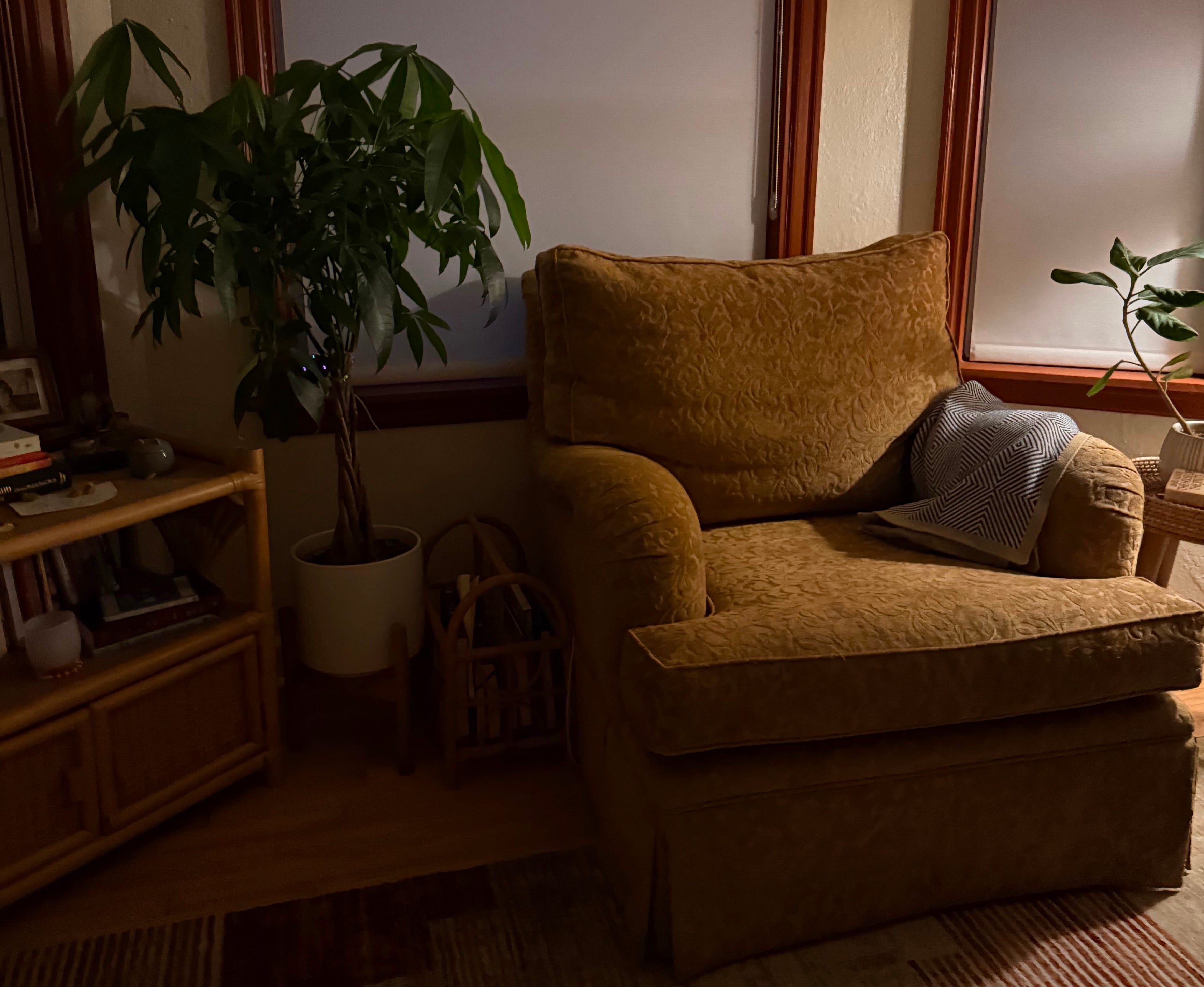
I woke up early to meditate around 4am, long before sunrise in the morning quiet that I have grown to love so much. I sat down, closed my eyes, and lasted three minutes before I couldn’t bear it anymore. I got up and curled into my cozy queen chair, the one I bought on Facebook Marketplace for $30 just a few months ago, and opened my laptop. I wrote the whole essay in one draft, the story and all its details I had held in for two decades, finally flowing out in one stream of consciousness - all while my daughter slept in the next room.
Then I moved through the normal morning routine and drove her to school.
The essay was sitting on my laptop, unpublished, while I drove. And the whole way there I thought about tagging him. His name, his business, his face. I wanted to yell from the rooftops what he was. I wanted to launch a missile from my cozy chair on a random Tuesday morning and watch it land from a safe distance. I wanted the girls in that community to know. I wanted the mother of his children to know. I wanted his clients to know. I wanted the people who gave him the Best Personal Trainer award three different times to know what they had put their name on.
I dropped my daughter off at school and while I drove home I talked to people I trust, and they helped me understand what I had to lose. So I changed his name and the names of the people who enabled him, and I came home and I published it anyway.
My story, minus one very key detail.
I told myself: at least I am saying something. At least I am not silent.
And then the comments came.
I want to tell you what the comments said. Not to perform my own pain, but because I think most people do not know what the landscape looks like from the inside. I think people imagine that survivors stay quiet because they are ashamed, or because they are afraid, or because they have been legally silenced. And sometimes all of those things are true. But I also think people stay quiet because they have watched what happens to the ones who don’t, and they have done the math, and the math does not work out in the survivor’s favor.
Here is what I have been told since I came forward with my story.
I have been called a slut. I have been told I must have liked it. I have been told it didn’t matter because I was seventeen, close enough to an adult, time to move on. I have been told my story is boring. I have been told my memory is unreliable and I don’t know what I’m talking about so my story means nothing. I have been shamed for not pursuing legal action, both then and now, with the assumption that if I don’t pursue it the violation must not have been that bad. I have been accused of receiving a cash settlement and staying quiet about it. I have been told that everyone’s a victim now. I have been told to kill myself. And these are not coming exclusively from men - many are coming from other women.
A stranger left a thinking face emoji on my disclosure. That’s it. No words. Just: 🤔. One stupid little emoji, registered in two seconds, costs nothing to deploy. And I carried it for days. It stuck more than any kind comment built me up, even though I consciously know how dumb that is. That is not a personal failing. That is how the human brain works - we are wired to weight threat above safety, doubt above belief, the one voice of skepticism above the chorus of recognition. It is a cheap weapon and an expensive wound.
And I have been asked, more times than I can count, why I didn’t share his name.
This one I want to sit with for a moment. Because I understand why people ask. They are thinking about the girls in that community (I am too). They are thinking about his current clients and whoever is in his orbit right now (I am too). They believe - and they are not wrong to believe - that naming him would be the most powerful thing I could do (I do too). Some of them have told me directly: you are enabling his abuse by staying silent. You owe it to the community to say his name. You are protecting him.
Here is what those people do not know.
I tried. Not at seventeen, when I didn’t yet have the language for what had happened to me. When I signed a document I didn’t fully understand because I was a child who needed someone to tell her it wasn’t her fault, and instead was told not to ruin his life. I want you to sit with that for a moment. Don’t gloss over it. I was seventeen years old. I had been manipulated into having sex with an older man in a position of power and I worked up the courage to tell a trusted adult. Another male personal trainer at that. Someone who went on to publish a book about his own childhood trauma after all of this. Imagine how nervous I was to tell him. How much it took for me to get those words out of my mouth. The shame and embarrassment I had to break through. And that adult looked at me and said: stop talking. You are wrong. Don’t ruin his life.
Wouldn’t you have signed it too?
An already broken seventeen-year-old’s reservoir of hope is not that deep. You take what little you have left and you go quiet and you try to rebuild your life.
That document only needed to keep me quiet for three years, and it did exactly that. The statute of limitations expired, and he went on to win Best Personal Trainer for the city, three different times.
His name is on an award and mine is in a comment section, being told that I enabled his abuse by not saying it out loud.
But the people telling me to say his name are only one part of the landscape. There is a much larger machinery at work in the comments, and it operates the same way every time (I am quickly learning).
When I wrote about my experience, a stranger responded with a link to a random blog post about how human memory is unreliable - how memories may come to you in vivid detail but could be partial or total lies. When I wrote about the CNN investigation into a Telegram group of men coaching each other through how to drug their wives, the comments filled with people debating whether 62 million visits to the site was really an accurate number - whether it was unique visitors or total visits, whether the methodology was sound, whether technically speaking the number was even that unusual for a porn site during the shortest month of the year.
But it’s not even about the methodology anymore. That debate has come and gone. What’s left is something uglier: men doubling down on the narrative that women are intentionally spreading false information. That we are sensationalizing the news to vilify an entire gender. That our outrage is not a response to harm but a weapon aimed at them. They are not arguing about the number. They are arguing that we are dangerous for caring about it being anything other than 0.
And on the other side are women trying to explain, over and over, that this is a pattern. This is not an isolated incident. There is not only one Telegram group. There is not only one website. This is an undeniable pattern. 4-5 women die in domestic violence incidents per day and 1 in 3 women will experience some form of sexual violence in their lifetime. We don’t care about the number anymore because we all carry our own fucking numbers. Our own stories. Our own hands on our throats that were never discussed. Our own documents signed at seventeen. Our own statutes that expired while we were still finding the language and the strength to share what happened to us.
The men are arguing about data because they have never had to live any of the reality of the stories. The women are arguing from their bodies because we feel it there. Because our memories are stored there, whether we want them there or not. The two conversations are not even in the same room.
Men do not know what it feels like to be hunted. Not in the way women know it - the calculation that happens automatically when you walk to your car at night, the read you do on every man in a room, the micro aggressions we endure every day. And because they don’t know that feeling in their bodies, they also cannot fully see their own contributions to it. The comments. The glances. The porn they consume without thinking about who is in it. The stories they dismiss. The jokes they let slide. The drunk friend they don’t stop. None of it feels like hunting to them. It doesn’t feel like anything. It is just the water they swim in, invisible because they have never had to name it, because the water was never trying to drown them.
And perhaps that is partly a protection mechanism. Because to look at it clearly - to really see the hunting, to trace the water back to its source - would require them to consider their own place in it. And that is a thing the psyche will work very hard not to do.
I think part of it is this: no one knows how to fix it. The problem is too large, too systemic, too woven into everything for anyone to point at a single solution and feel better. And so the men pick it apart until it feels small enough to debate and distant enough to manage. And the women keep trying to show what it looks like from the inside, and keep being met with products of the very system they’re trying to describe.
We are not even in the same crisis.
I posted my essay in a men’s subreddit for a little experiment. Not a right-wing space, not a troll farm, but a subreddit for self-proclaimed left-wing male advocates. It was downvoted within minutes. One commenter even built a little skit -
“Feminists: 62 million men are rapists!!!
Anyone: Actually, you can’t interpret that number as...
Feminists: You just outed yourself as one of them!”
Nobody in my essay said 62 million men are rapists. But the caricature let him dismiss the argument without reading it. Another said I brought “no new arguments into discussion. Just re-framed.” As though reframing - as though asking men to feel it instead of just debating it - were not the entire point. Another went through the essay line by line and wrote: “I’d have taken this more seriously if it was approached gender neutrally. The whole piece could be described as ‘Female chauvinism raising its ugly head.’” An essay about men drugging their wives is female chauvinism. An essay about women being choked without consent is gender bias. The only acceptable version of this essay, apparently, is one that doesn’t mention who is doing it to whom.
These are not trolls. These are men who consider themselves progressive. Men who would tell you, without hesitation, that they believe women. That they are one of the good guys. They have wives and mothers and sisters and daughters. And they spend their time pecking away at survivor stories in subreddit threads.
And the ones who didn’t peck away? They said nothing. Not one man in that subreddit stood up publicly. At one point I watched the downvote count climb to 27 and noticed a single upvote appear. One man, somewhere, clicked an upvote arrow and moved on. Was that him being an ally? Seeing what was happening and deciding that was enough?
I do not expect men to defend me. I am not owed that. But I want to be honest about what that silence feels like from where I’m standing. It feels like being ganged up on, ridiculed, called stupid, dismissed - and watching the men who call themselves allies decide that an upvote is enough. That a private laugh at a misogynistic joke doesn’t count. That looking the other way when their drunk friend goes home with a girl who doesn’t want to go is not their problem.
You are not one of the good guys because you didn’t say the bad thing. You are one of the good guys if you say something when it matters. Those are not the same standard and we have been letting men confuse them for too long.
When women say “all men” they are speaking systemically. All men are products of the water. All men carry internal programming from the same culture, whether they are aware of it or not. When men hear “all men” they hear: you are calling me a rapist. My husband is not a rapist. My son is not a predator. So it’s not all men. The two sides are not even having the same conversation. Women are describing the water. Men are defending individual fish.
“Not all men” is the oldest exit ramp of them all.
When I named one commenter’s use of the phrase “performative panic” as a revealing thing for a man to say about a woman writing about sexual violence, he wrote a 120-word reply explaining that I was ignoring his mathematical argument in order to focus on my feelings - and that this was itself evidence of performative panic. There is a specific thing that happens in these exchanges where a man needs you to be less intelligent than him in order for his argument to hold. He is the rigorous one. You are the emotional one. And if you push back, the pushing back becomes further proof that you are too hysterical to be taken seriously.
The circle closes and the number is disputed. The woman defends the number. The defense proves she is hysterical. The hysteria proves she cannot be trusted with numbers. And the drugged wives disappear entirely.
All of these moves have something in common. They present themselves as more rigorous than simply believing the survivor. The person making them gets to feel appropriately skeptical, intellectually careful, even superior. They are the reasonable one. The survivor is the one being emotional, hasty, unscientific, insufficiently critical.
But actually they are just refusing to feel it. And the refusal has a pattern: find the detail you can argue about and anchor the debate there. By the time the argument is exhausted, the story has disappeared. The commenter gets to feel rigorous and careful and appropriately skeptical, and the survivor is left alone with the thing that happened to her, which is now also public, and now also disputed, and now also somehow her fault for not sharing his name or not pursuing legal action or not having a better memory or not being less hysterical about it.
I call it the exit ramp. The detail that lets you pull off the road so you never have to drive through the dark.
I am twenty years removed from what happened to me. I have been to therapy. I have traveled the world searching for meaning. I have studied yoga for thousands of hours and done the breath work and the meditation and the EMDR. I have processed it. I have worked really damn hard to process it and I have built a life on the other side of it. I am 38 years old, I have a daughter, I have a thriving community and a lot of genuinely wonderful people in my life. I have every advantage a survivor could ask for. The wound is old, scabbed over.
And this process - the process of naming it in public, and then defending that I named it, and then defending that I have the right to name it - is brutal in a way I was not fully prepared for. That I could not have been fully prepared for. Not because I am fragile but because the landscape is genuinely, deliberately hostile and toxic.
I cannot imagine doing this with a wound that is fresh. I cannot imagine being 18, or 22, or 25, and having just survived something, and then trying to survive this - the landscape that meets you when you say it out loud. And I do not have to imagine why women stay quiet.
This is why. Not because we are weak. Not because it didn’t happen. Not because we aren’t sure if it was a violation worth being hurt over. But because the cost of saying it out loud is so high, and the return is so uncertain, and the ceiling is so low.
And if we want more survivors to come forward - if we actually mean it when we say we want the culture to change, when we say we believe women, when we say we want the Brads of the world to be held accountable - then we have to be honest about what we are asking them to walk into.
We are asking them to do what I did. To write the essay in the dark at 4am. To change the name. To post it anyway. To read the comments. To carry the thinking emoji for days. To rip off the scab of their deepest wound and let it be circled and ruthlessly attacked by internet trolls and assholes. To do all of that knowing that the ceiling is a changed name on a Substack with a small but growing readership and the floor is being told to kill themselves.
We are asking them to do that for a landscape that is not ready to receive them.
I don’t know how you change a landscape. I have thought a lot about it and I don’t have a clean answer and I am suspicious of anyone who does. I know that the people who leave thinking emojis on survivor disclosures will not read this essay. I know that the men who need a woman to be hysterical so they don’t have to sit with what she’s saying will not be moved by my asking them to sit with it. I know that the statute of limitations will keep expiring and the awards will keep being given.
I know that I am tired. And I know that I will keep writing anyway, because my daughter is asleep in the next room and she is going to move through a world that was not built with her safety in mind, and the least I can do is tell the truth about it while she is still young enough that it might matter.
But I want to be honest with you about what that feels like from the inside.
It feels like launching a missile on a random Tuesday morning and watching it land and then standing in the rubble and being handed a skeptical thinking emoji. It feels like the ceiling is very low and the floor has no bottom and somewhere in the middle is a changed name on a small Substack and somehow that has to be enough.
It isn’t enough.
But it is what we have.1
Credit to creator Kristen Shelt (@kristenshelt on Substack/TikTok) for the "operating system" framework that shaped my thinking. Her articulation of why women say "all men" as a description of shared conditioning rather than individual accusation clarified something I had been circling for weeks.
This is a really important essay, Hannah. I'm so sorry for all that you endured, and continue to endure. Your analogy is apt and illuminating. We - especially men - are like fish swimming in the large ocean of abuse, trauma, and internalized patriarchy. A fish doesn't know what wet is if it hasn't known anything else. We need to sit with stories like this until we can see it, feel it, and get it about what is going on all around us. And then take a stand.
Another excellent writing, Hannah.
Having investigated child abuse and sexual assault as a profession, I’ve often interviewed adults who were the victims of child sexual abuse. Some reported the abuse as children. Some never did until I contacted them in my related case.
An important question I always asked the “late reporters” is why they waited until later to disclose. No, it wasn’t to shame them. It was very important for a jury to understand why victims held on to this for so long.
Common replies included:
“He said he would hurt me or my family if I told anyone.”
“I didn’t think anyone would believe me.”
“I was ashamed.”
“I thought people would say I wanted it.”
“I thought people would say I was gay (boys).”
“I told my mom/pastor/etc. but they said it would ruin our family or his family if we reported it to the police.”
“I did report it. But it was my word against his. He was a (businessman, teacher, powerful somebody) and I was a (nobody). Nothing happened. “
And yet, we somehow crush these victims who disclose their abuse 10, 20, 40 years later. We blame them when their abusers find other victims. Had that 6 or 17 year old been “brave” and reported what happened, the predator wouldn’t have found more prey. We’ve lost all empathy and hold them to a retroactive standard to which we wouldn’t hold our own children. Shame on you. Do better.